
Our Story
From a grandmother’s kitchen
to your phone.
Three generations. Four cuisines. One stubborn promise — that no recipe in this family would ever again be lost to a forgotten WhatsApp thread or a tea-stained scrap of paper.
1960s · Manama, Bahrain
The grandmother who started it all
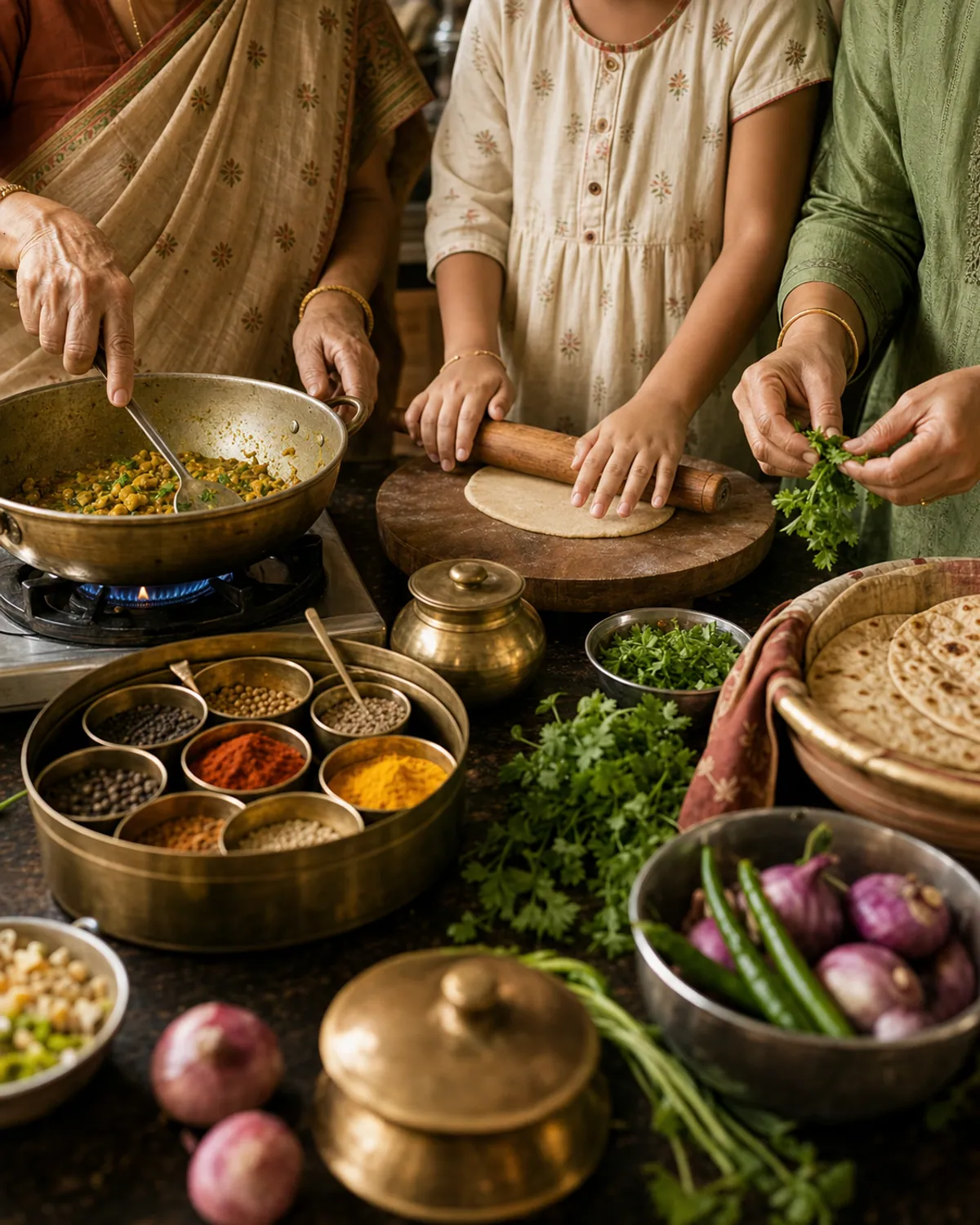
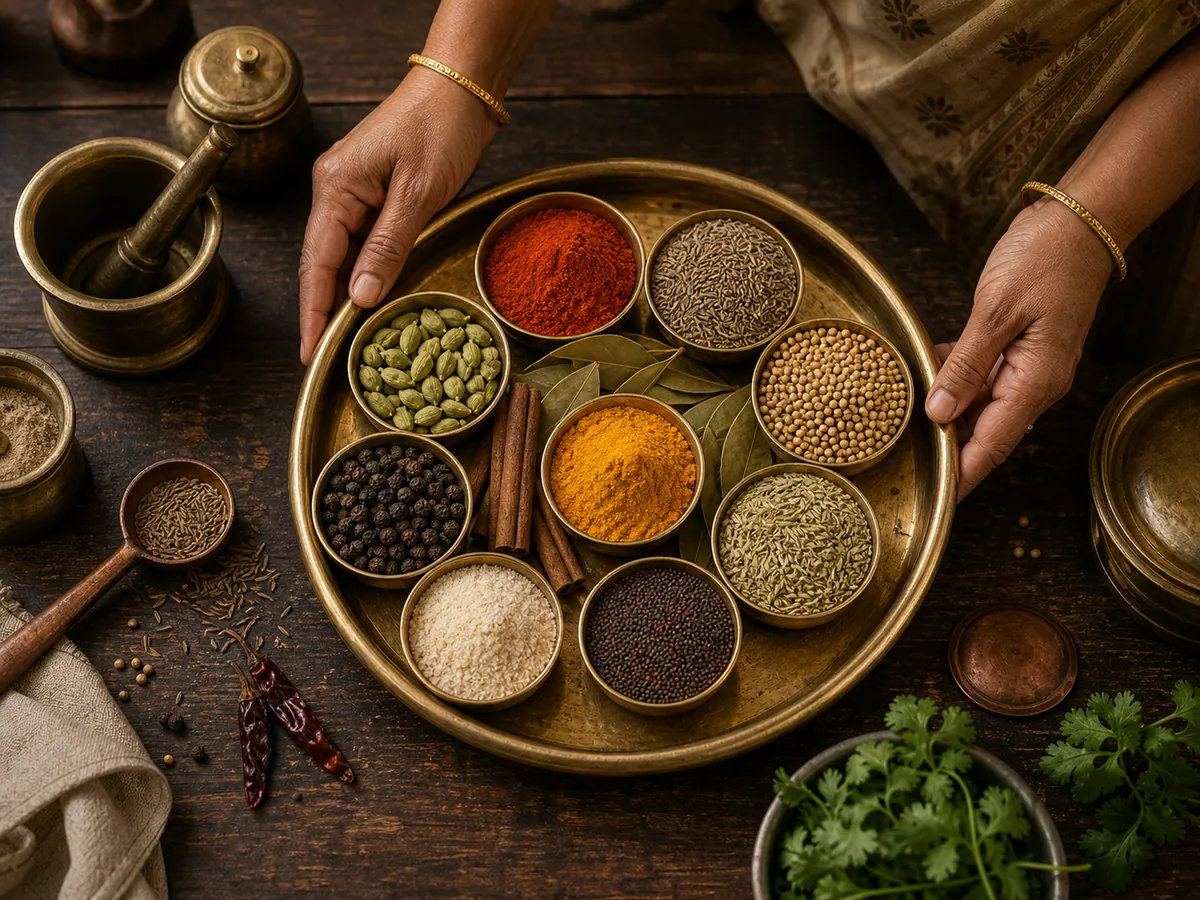
Our story begins in a coral-stone house in old Manama, in the smoke-perfumed kitchen of a Hindu Bhatia family — essentially Sindhi, with roots that went deep into pre-Partition Karachi — who had crossed the sea to Bahrain in 1948 with little more than two copper pots and a stack of hand-written recipes wrapped in muslin. The copper pots are still in the family. So are the recipes.
Nani — everyone’s grandmother, even the children who weren’t hers — ran a kitchen that fed twenty on a Sunday and forty on Diwali. She measured nothing. A pinch of asafoetida was “the size of a small lentil.” Tamarind was “until it tastes right.” She knew her sai bhaji was done when the brass kansa rang a particular note as you stirred it. We are still trying to hear that note.
Her three daughters grew up alongside three cuisines: the Bhatia food of their own kitchen, the broader Sindhi cooking of the wider community — cousins, aunts, the weekly visits to other family homes — and the Gujarati food of the neighbours upstairs who taught Nani how to make a proper khandvi.
1970s · The wider circle
Nani didn’t do it alone.
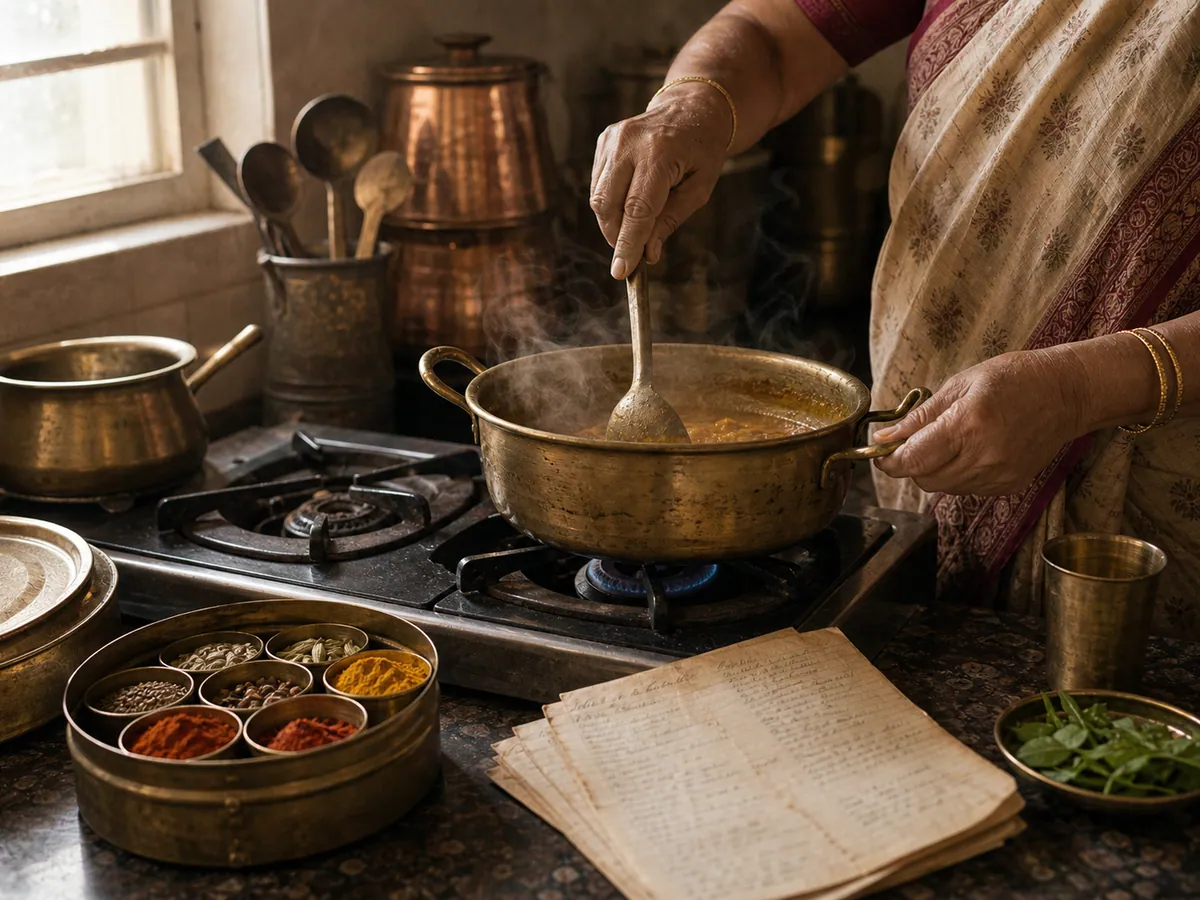
It would be a small story if it were only one grandmother. Every family kitchen is held up by more than one pair of hands — and ours was held up by a circle of elders who each carried a piece of what we now call the recipe book.
The Masis — mother’s sisters — and the Mamas — mother’s brothers — made the festivals what they were. The aunts rolled the papad. The uncles tempered the dal. Sunday lunches were hosted at one house or another, where the whole family showed up unannounced and somehow got fed. The grandchildren learned how to fry papad on an open flame without burning it. Recipes got written in Sindhi script on the back of grocery receipts. We don’t say first names in front of strangers — that’s a tradition older than the recipes.
And then there were our mothers and fathers — the daughters and sons and the cousins-in-law — who took what they grew up watching and adapted it for whatever country they ended up in. They were the bridge generation. They taught us, the grandchildren, that a recipe is not just a list of ingredients. It’s a story about who taught it to you.
For Nani · for the Masis and Mamas · for the bridge-generation parents who taught us to translate Sindhi recipes into the languages of new countries · and every elder who quietly held a kitchen together while the rest of us were learning how to boil rice.
“Every recipe tells a story.
Every meal brings us home.”
1990s · The diaspora begins
One kitchen, six cities
By the mid-90s the family had begun to scatter the way diaspora families do. The eldest moved to Dubai for an oil-and-gas job that was supposed to last two years and lasted twenty-five. The middle daughter followed a husband back to Mumbai. The youngest stayed in Bahrain, then a decade later crossed half the world to Wellington. The grandchildren landed in Sydney, Auckland, and a quiet street in suburban Toronto.
Wherever anyone went, they took the recipes with them — or thought they did. What they actually took were fragments. A WhatsApp forward of bhee curry that said “1 cup oil” when it should have said 1 tbsp. A scribbled sindhi kadhi that didn’t mention the besan needed roasting first. An aunt’s dal pakwan that everyone made differently and nobody made quite as well.
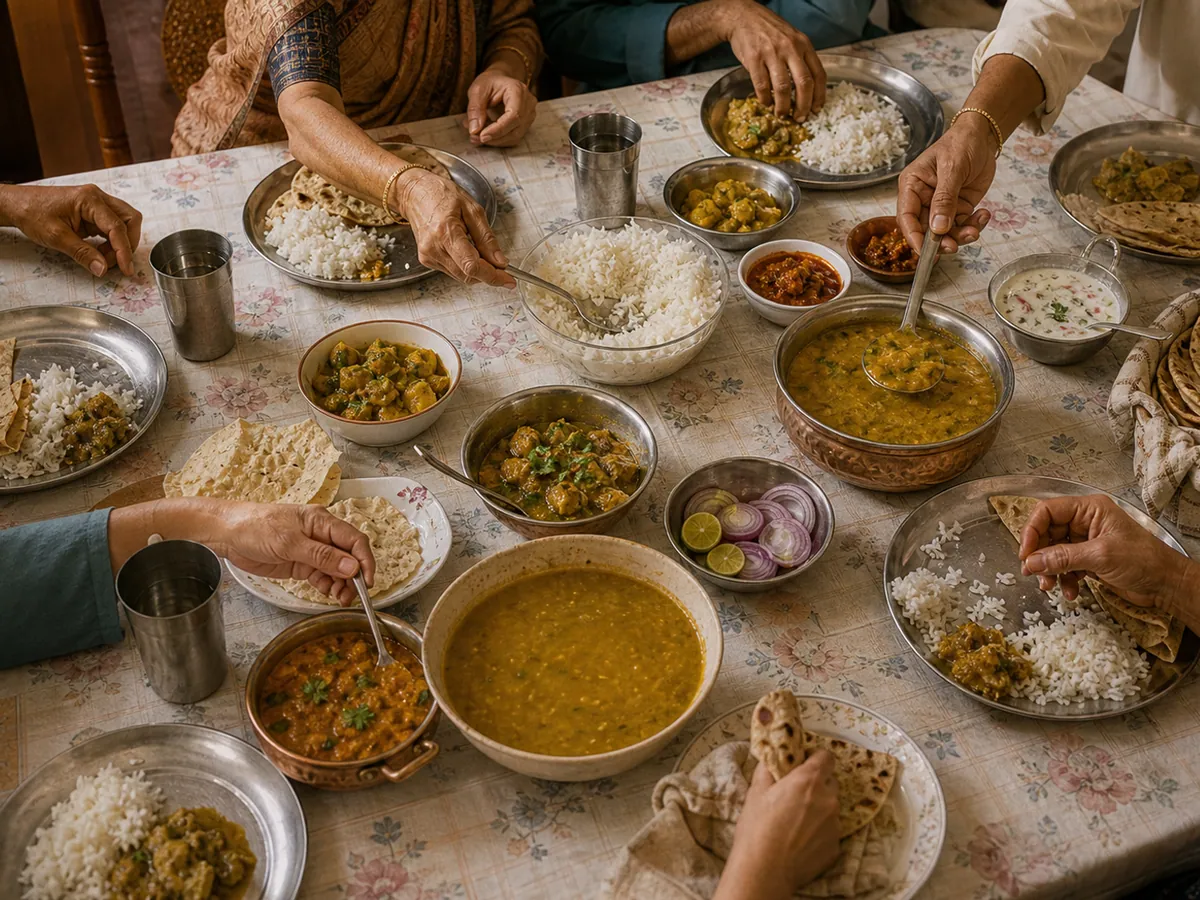
For a while, the kitchen group chat was the world’s most chaotic recipe book. Photos of papad held against window light to read faded handwriting. Voice notes at 2am that said “you put the jaggery in last, beta.” Frustrated arguments about whether the cumin goes before or after the mustard seeds. (Both. Different recipes.)
2010s · What we almost lost
The recipes started disappearing
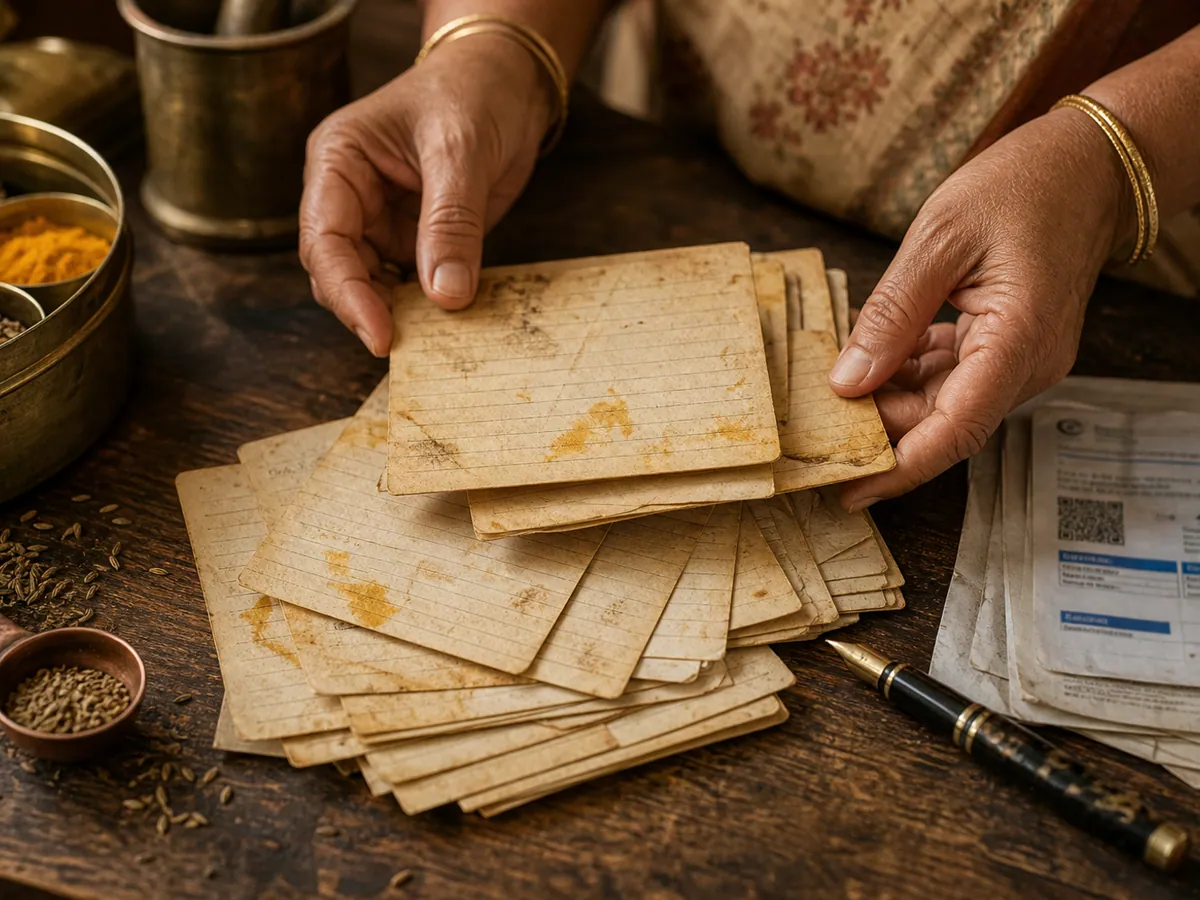
By the early 2010s the family had started losing its elders, one by one. Quiet aunts. Loud uncles. Patriarchs and matriarchs of branches that had moved decades earlier. Each one took a chapter of the unwritten book with them — a particular way of folding a khandvi, a particular temperature at which a kadhi should bubble, a particular note the kansa was supposed to ring.
Nani is the living archive. She still cooks daily, still measures asafoetida by feel, and her video calls from Wellington usually end with “you are chopping the onions wrong.” Her three daughters, scattered across three continents, can each reconstruct about a third of her repertoire — different thirds. So we started, in earnest, to write everything down: what Nani still cooks every week, what her daughters carry in their hands, and what the old kansa pots are the only ones left who could now teach us.
The grandchildren — bless them — could each cook about four dishes from memory. Mostly the easy ones. Aloo tuk, because it was forgiving. Koki, because you could eat it without anyone watching. Sindhi kadhi that wasn’t quite right because nobody had told them to dry-roast the besan first.
That was when we realised: a recipe collection isn’t a luxury. It’s the difference between a family that knows where it came from and one that’s guessing.
“A recipe collection isn’t a luxury.
It’s the difference between a family that knows where it came from
and one that’s guessing.”
2024 · The idea
One place. Proper measurements. No more arguments.
We started building a private family cookbook in late 2024. The rules were simple. Every recipe needed a real measurement (no “to taste” without a follow-up note explaining what that taste was). Every recipe needed steps, not just ingredients. Every recipe needed to be searchable, because nobody has time to scroll a thousand WhatsApp messages looking for that one patra recipe an aunt sent in 2018.
We added a meal planner because two of us are diabetic and need to think about what the week looks like. We added a macro tracker because one of the grandchildren is a swimmer who needs to know her protein number. We added a shopping list because nobody wants to chop an onion only to discover there are no onions.
Then the neighbours started asking. “Can you share that recipe?” Then the colleagues. Then a stranger emailed from Calgary saying she’d found us via Google searching for “sindhi kadhi besan roasting” and could she please have the link. So we opened the door.
Today · What this is
A working family recipe book — left unlocked.
Desi Family Kitchen is the cookbook our family wishes it had had thirty years ago. 900+ recipes, mostly Sindhi, Bhatia, Gujarati, and pan-Indian, with detours into Italian, Mexican, Indo-Chinese, and the food we actually cook on a Tuesday night when nobody has the energy for dal-baati.
We don’t just cook what our grandmothers cooked. We cook what the whole circle taught us — the patra steamed in muslin, the sai bhaji simmered for an hour, the Sunday dals that always tasted of patience, the papad fried over an open flame, the recipes written in Sindhi script on the back of grocery receipts, and Nani’s entire kitchen. We cook what every elder in our lives would cook if they lived in Wellington in 2026 — with a Lebanese pantry shipped from Dubai, a Filipino dairy down the road, and a daughter who eats vegan three days a week. That’s why you’ll find baked chorafali next to a vegan walnut-pesto, and a paneer tikka burger next to sai bhaji that hasn’t changed since 1962.
Every recipe is free. Every recipe is searchable. Every recipe has a real measurement and a real step. If you spot a mistake — and you will, because we are still learning — email us at [email protected] and we will fix it.
This isn’t one grandmother’s story. It’s every elder’s — the ones still cooking in Manama, Mumbai, Bahrain, and Wellington, and the ones who came before us. They preserved a way of cooking, and a way of being a family, that no individual cook could have held alone.
The timeline at a glance
- 1948 Family carries two copper pots and a stack of muslin-wrapped recipes across the sea from Karachi to Bahrain.
- 1967 Nani cooks for forty at Diwali in Manama. Measures nothing. Feeds everyone.
- 1970s Three generations in the same kitchen. The aunts roll papad. The uncles temper the dal. Nani directs traffic. Nobody measures anything.
- 1994 First branch of the family moves from Bahrain to Dubai. WhatsApp doesn’t exist yet. Recipes start travelling by aerogramme.
- 2013 An elder passes. Family realises there’s no recipe book. The reconstruction begins.
- 2018 The family WhatsApp group hits 9,000 messages. Most of them are recipes. None of them are searchable.
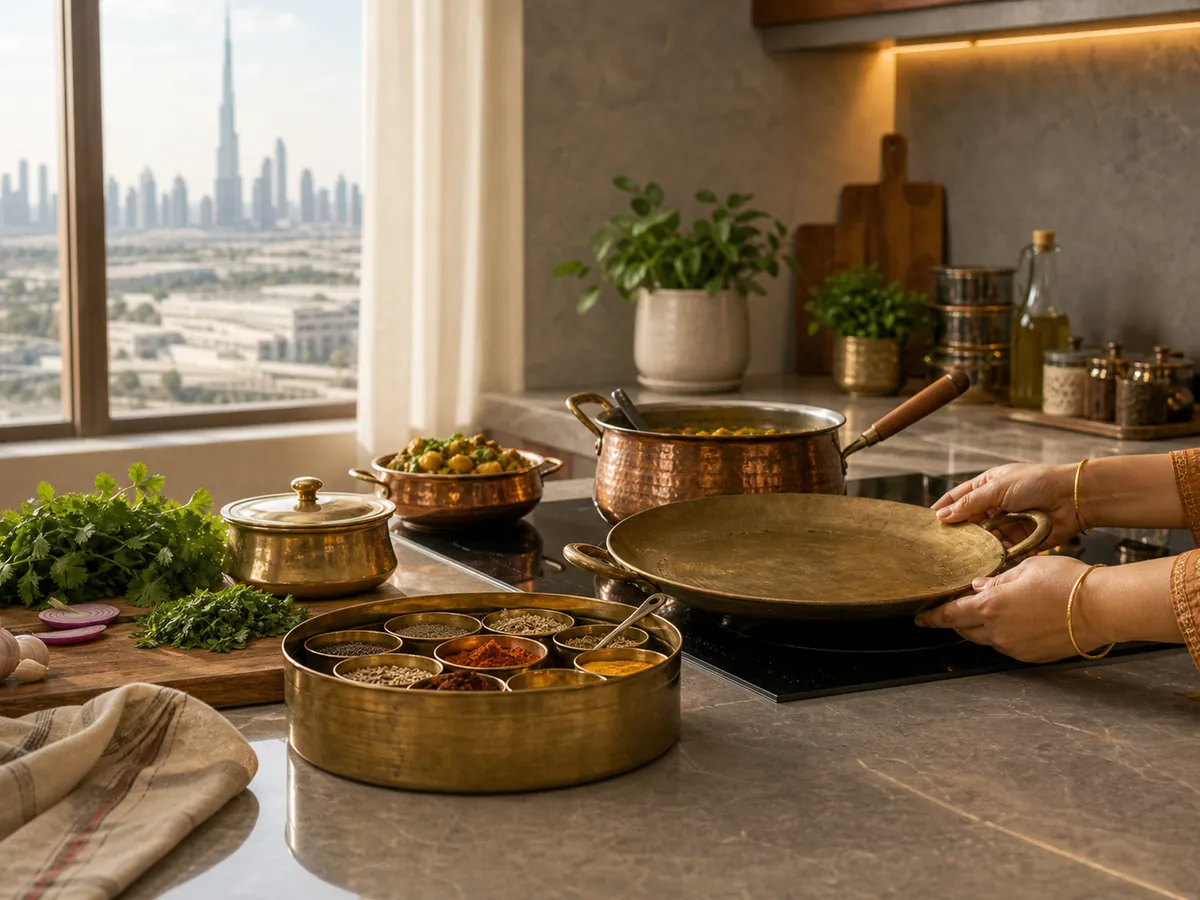
- 2022 Youngest daughter moves her household from Bahrain to Wellington, New Zealand. Brass tawa goes with her.
- 2024 First version of the family cookbook goes online. Forty recipes. Three users. All cousins.
- 2026 Cookbook crosses 900 recipes. Opens to the public. You arrive.
“We cook what our grandmothers would have cooked
if they lived in Wellington in 2026.”
Why we keep doing it
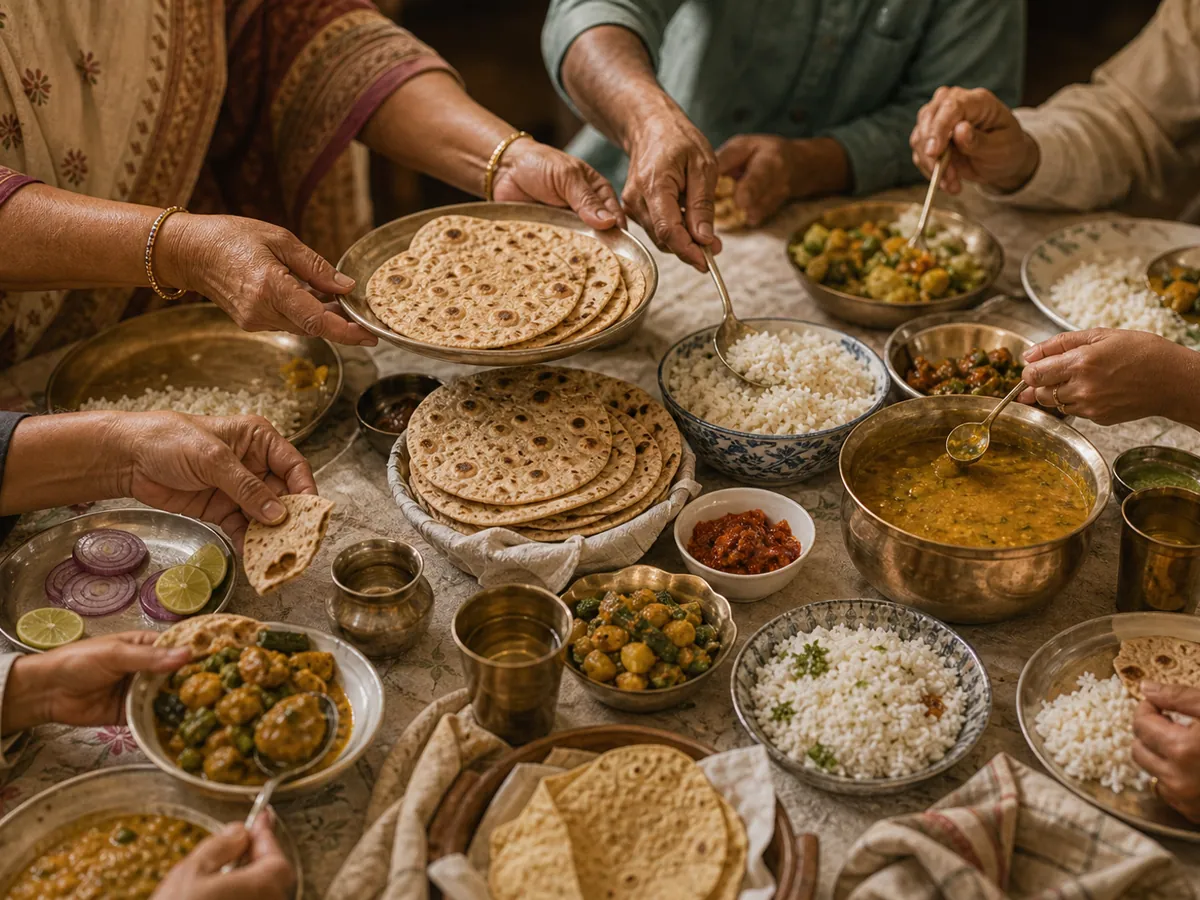
Because the table is the family.
The recipes are the visible part. What we’re really preserving is the reason for the recipes — the long Sunday afternoons, the cousins who haven’t seen each other since 2019, the grandchild who learns aloo tuk at her father’s elbow and someday teaches it to her own child without ever having read it written down.
If you cook something from this site and it ends up on someone’s table, you’re part of this story now.